
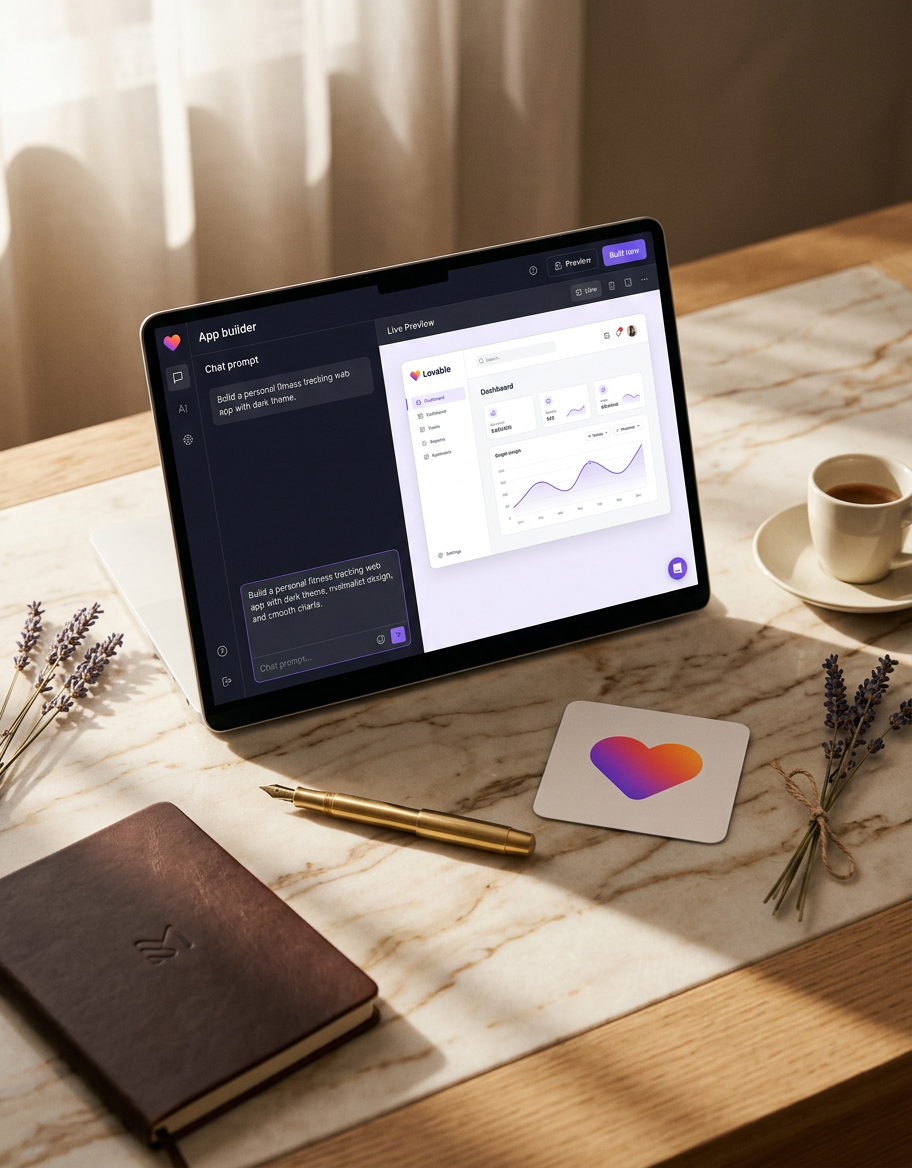
Shipping five Lovable apps in 30 days proved that success in 2026 isn't about coding speed, but about idea velocity and distribution. The best builders will treat Lovable as a high-leverage 'systems thinker' co-pilot, not a magic app factory. This means focusing on niche problems and building an audience from day one is more important than ever.
Most 'build in public' challenges are vanity exercises. A flurry of screenshots, some impressive-looking GitHub stats, and maybe a small app that disappears after a month. I wanted to do something different. My goal for this 30-day sprint was to stress-test the reality of building with AI in 2026. Not just to see if I could build five apps with Lovable, but to discover the new playbook required to make it matter.
Could I go from idea to paying customer in a week? Is the code quality a liability? And most importantly, where is the actual leverage? Is it in the prompt, the tool, or somewhere else entirely? I learned a lot. Some of it was surprising. All of it is useful if you plan on building anything in the next few years.
The Challenge: Why Five Apps in 30 Days?
This challenge was designed to simulate the high-iteration environment that AI tools promise. The goal was to launch five distinct, minimal-but-viable AI applications, each targeting a different niche, and to do it all within a 30-day window. This wasn't about building five half-baked demos. Each app had to solve a real problem, have a clear path to monetization, and be launched to a real audience, no matter how small. A tight deadline forces you to be ruthless about scope and focus on what truly delivers value.
The five app concepts were:
- RealtyCopy AI: Generates compelling real estate listings from a few bullet points.
- KiddieTales: Creates personalized bedtime stories for children based on their name and interests.
- Receipt-AI: An OCR-based tool that extracts line items from receipts and categorizes them for expense reports.
- GitCommitter: A VS Code extension that uses your staged changes to write conventional commit messages.
- GrowthTweet: Analyzes a user's Twitter/X profile and suggests high-engagement tweet ideas.
Some of these ideas worked better than others. One was a complete dud. That was the whole point. The sprint was a laboratory for testing not just the tech, but the ideas themselves.
The 'Just Ship It' Stack of 2026
The optimal stack for rapid iteration in 2026 is all about minimizing friction between idea and execution. Lovable is the star of the show, but it's part of a broader ecosystem where each piece is chosen for its speed and simplicity. This stack feels less like traditional development and more like orchestrating a set of powerful, specialized services.
Here's how my AI-first stack compared to a more traditional approach from a few years ago. Look, the difference is stark.
| Component | Traditional Stack (c. 2023) | AI-First Stack (2026) | My Take | | :--- | :--- | :--- | :--- | | Frontend | Manual React/Next.js, Tailwind CSS | Lovable (prompt-driven UI/UX) | Lovable gets you 85% of the way there on UI. You aren't writing CSS, you're describing layouts and interactions. It's a huge mindset shift. | | Backend | Node.js/Express, Python/Django | Supabase + Edge Functions | Supabase is the perfect backend for an AI-first builder. It handles auth, database, and storage with zero fuss. Edge functions are great for quick API integrations. | | Deployment | Vercel / Netlify | Vercel | Some things don't change. Vercel's integration with the Next.js code that Lovable generates is still flawless. Push-to-deploy is non-negotiable. | | State Management | Redux, Zustand, React Context | Prompted state logic in Lovable | This was a surprise. You can prompt Lovable to manage state. "When a user uploads a receipt, store the image URL in state and set the 'processing' status to true." It works, but requires precision. |
This stack is brutally efficient. The time spent on boilerplate setup- a day or two in the old world- is now measured in minutes. All your energy is redirected towards the unique logic of your app and, crucially, getting it in front of users.
Lesson 1: Lovable is a Systems Thinker, Not Just a Coder
The most critical lesson is that you must treat Lovable like an architect, not a line cook. The biggest mistake beginners make is giving it tiny, component-level instructions. This is slow and inefficient. You're using a supercomputer to do basic arithmetic. The real power comes from prompting entire systems and user flows.
Don't do this:
- "Create a blue button with the text 'Sign Up'."
- "Make an input field for an email address."
- "Now add a password field below it."
Instead, do this:
See the difference? The second prompt describes a system. It outlines the components, the data flow, the third-party service integration, and the conditional user experience. You're delegating the implementation details- the `useState` hooks, the API calls, the routing logic- to the AI. Your job shifts from being a bricklayer to being the architect who provides the blueprint. This is where the 10x speed gains actually come from. You think in terms of outcomes, not code.
Lesson 2: Idea Velocity Trumps Code Velocity
The speed of AI development tools creates a new bottleneck: the quality and validation of your ideas. The thing is, building faster doesn't matter if you're building the wrong thing. What AI tools like Lovable truly unlock is an insane increase in idea velocity - the speed at which you can test a hypothesis with a real, working product.
My first app, RealtyCopy AI, is a perfect example. I built a functional prototype in two days. I sent it to ten real estate agents I found on LinkedIn. The feedback was lukewarm: "It's neat, but my brokerage already provides a similar tool." Total time from idea to validation: 72 hours. In the past, that would have been a month-long, multi-thousand-dollar project. With Lovable, it was a weekend experiment.
I killed the project immediately and moved on. Compare that to KiddieTales. I built the prototype in a day. I shared it in a Facebook group for parents. The reaction was instant and emotional. People were posting the stories their kids loved and asking how they could pay for it. That's the signal you're looking for. The ability to churn through ideas and discard the duds without emotional or financial attachment is a superpower. Your new job as a builder is to maximize the number of at-bats you get.
Lesson 3: The Moat is Distribution, Not Your Prompts
For a while, there was this fear that prompts would be the new proprietary IP. Honestly, that's a dead end. In 2026, anyone can use Lovable or a similar tool to clone your app's functionality in a few days. Your UI, your features, your core logic- they are all temporary advantages. My prompts for all five apps are public on my GitHub. Go ahead, take them.
You know what you can't take? The audience I built while making them.
Every day of the challenge, I posted updates on X and LinkedIn. I shared my prompts, my learnings, my failures (like killing RealtyCopy AI), and my wins. This 'building in public' wasn't just for accountability. It was a marketing strategy. By the time I launched GitCommitter, I had a waitlist of 500 developers who had been following the journey. The product launched to an existing, engaged community.
This is the new moat. Distribution is the only truly defensible asset in an age of infinite leverage. Your ability to build an audience, earn trust, and communicate a narrative is more valuable than your ability to craft the perfect prompt. The process of building becomes the content that attracts your first users. Stop guarding your ideas and start sharing your journey.
FAQ: Will Lovable Actually Replace Developers?
No, but it completely changes the job description. Lovable will not replace a developer with good product sense, but it will absolutely replace a developer who just translates tickets into boilerplate code. The value is shifting up the stack. It's moving away from writing verbose, repetitive code and toward high-level problem-solving.
The new role is something like an 'AI-Native Product Engineer' or 'System Architect'. This person excels at:
- Product Vision: Deconstructing a user problem into a system that can be described to an AI.
- Prompt Engineering: Crafting precise, system-level prompts that produce the desired outcome.
- Taste and Curation: Evaluating the AI's output and knowing what to keep, what to discard, and what to refine.
- Integration: Stitching together the AI-generated code with other APIs and services to create a cohesive product.
Lovable is like an incredibly talented, fast, but very literal intern. It still needs a senior architect to provide direction, vision, and quality control. That's the new job.
FAQ: What Kind of Apps Should I Build with Lovable?
You should build hyper-niche, workflow-specific tools that solve a painful problem for a defined group of people. The era of building another generic project management tool or a simple note-taking app is over. The market is saturated, and a solo builder can't compete with massive incumbents on features. But you can win on specificity.
Instead of building "an AI writing tool," build "an AI tool that helps junior lawyers draft discovery requests in the style of a specific law firm." Instead of "an image editor," build "a tool that automatically watermarks and resizes product photos for Shopify stores."
These 'long-tail' SaaS ideas were often commercially unviable before because the engineering cost to serve a small market was too high. With Lovable, that calculation changes entirely. You can now build and launch a niche micro-SaaS in a week. Your goal isn't to build a unicorn. It's to build a portfolio of small, profitable tools that serve specific communities. That's the sweet spot for AI-assisted development in 2026.
The Briefing
The best of Lovable, once a week.
Deep reviews, founder case studies, and growth tactics. No filler.
No spam. One-click unsubscribe.
Build something with us
Start Building with Lovable
Open Lovable, write your first prompt, and ship the thing you have been thinking about for too long.
Start Building with Lovable