
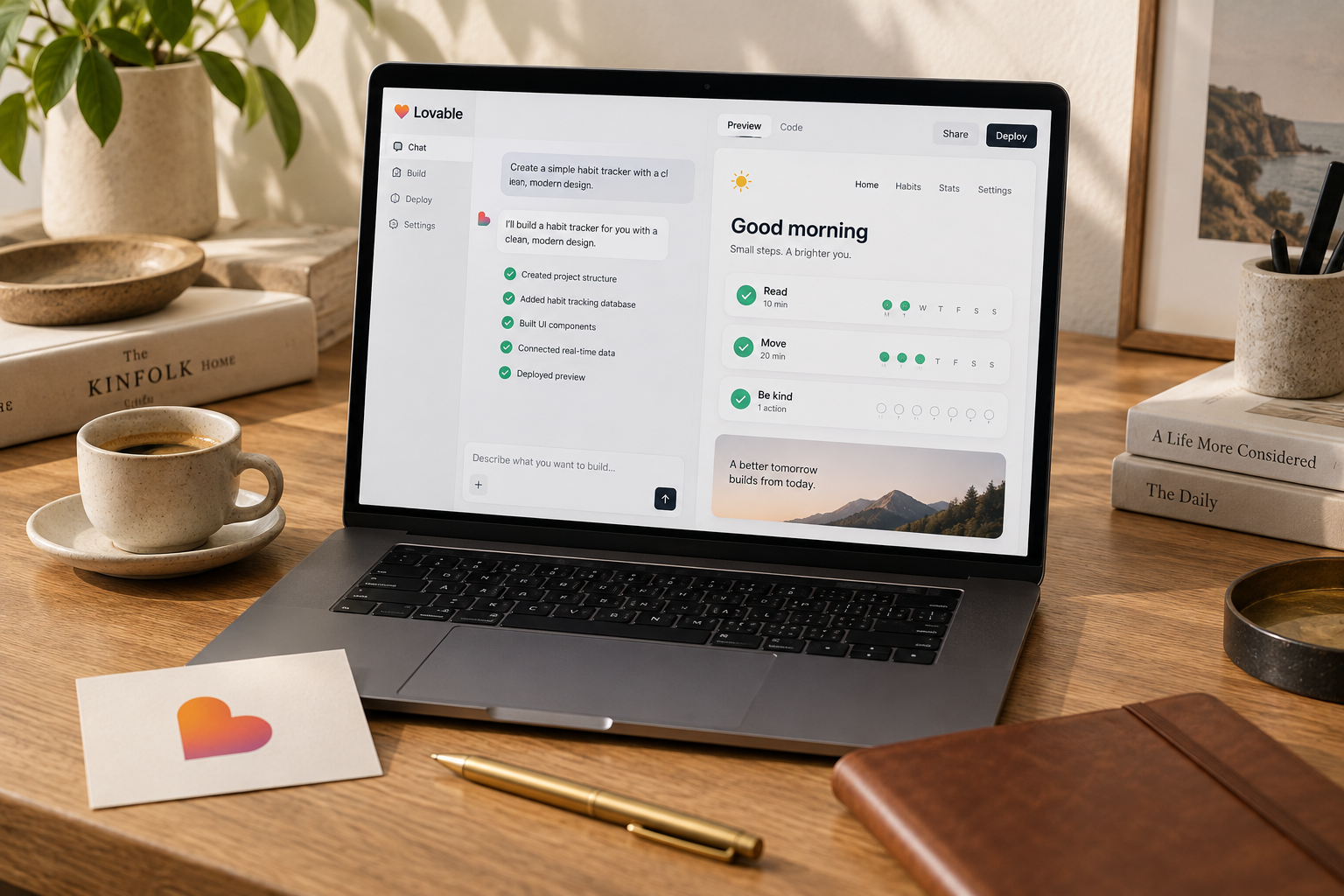
Lovable is a strong fit for browser-based apps with familiar screens and straightforward data workflows. It becomes a riskier purchase when your core feature requires native device capabilities, complex authorization, durable background processing, or strict performance guarantees. Test the hardest workflow before paying for a larger commitment.
Lovable works best for browser-based apps with familiar interfaces and straightforward data workflows. Its practical limits appear when your product depends on native device behavior, complicated permissions, long-running work, or guarantees that a generated demo cannot prove. This review explains those boundaries and gives you a two-hour evaluation plan before you commit money.
The verdict: where Lovable fits
Pay for Lovable when building the interface and connecting ordinary app workflows are your main bottlenecks. Do not buy it expecting difficult engineering requirements to disappear.
A customer portal with login, records, forms, and a dashboard is a sensible candidate. A collaborative video editor with offline synchronization is a very different purchase decision, even if both start with an impressive homepage.
The distinction is not whether Lovable can generate code for a feature. It often can. The question is whether you can verify, operate, and safely change that feature afterward.
This is a capability-fit review dated October 27, 2026, not a claim that we built 100 projects or benchmarked every current feature. Plan entitlements and service limits can change. Check current documentation and checkout terms before treating any capability as included in your subscription.
Use this first-pass filter:
| Your app's main requirement | Buying assessment | What you must verify | |---|---|---| | Forms, dashboards, searchable records | Strong candidate | Data persistence, validation, access rules | | Customer portal with private files | Good candidate with security review | Tenant isolation and file permissions | | Subscription SaaS | Conditional fit | Server-side entitlements and billing events | | Native mobile with deep device integration | Not a complete solution by itself | Native tooling and device-specific behavior | | Long-running imports or AI processing | Needs backend architecture | Queues, retries, timeouts, observability | | Real-time collaborative editing | Engineering-led project | Conflict handling and reconnection behavior | | Regulated or safety-critical workflow | Requires specialist assessment | Applicable controls, contracts, and audit evidence |
These are workload judgments, not claims that particular features are impossible. A developer can extend a generated app substantially. But once custom engineering owns the hardest part, evaluate Lovable as an accelerator rather than the whole solution.
One useful question: If the interface were already finished, what would still stop you launching? That answer identifies the feature your trial should test.
Six Lovable limits that matter
1. A mobile-friendly website is not a native mobile product
A responsive layout can look good on a phone. That does not establish reliable background location, Bluetooth access, native extensions, or offline behavior.
Wrapping a web app can be a valid distribution strategy, but it introduces another toolchain and another testing surface. App signing, store review, device permissions, and platform-specific bugs still need owners.
If your business depends on recording location while the phone is locked, test that exact behavior on physical devices. A successful browser preview tells you very little about it.
Buying rule: Lovable is easier to justify when mobile means customers using a website on their phones. Treat deep device integration as a separate engineering workstream.
2. Authentication is easier than correct authorization
A working login proves that someone can identify themselves. It does not prove they can access only the records they should see.
Complexity rises quickly when an app has organizations, contractors, managers, shared resources, and exceptions. Hiding an admin button is not an access-control system. Restrictions need enforcement at the backend or database layer, not just in the interface.
The dangerous case is a portal that looks private but accepts another customer's record ID in a request.
Test with two organizations and separate users. Attempt to retrieve, modify, and delete the other organization's data. Include uploaded files, not just database rows.
Buying rule: A multi-tenant app needs an explicit permission model and negative tests. A screenshot of a login page is not evidence of security.
3. Long-running work needs more than a loading spinner
Consider importing 20,000 rows, processing 200 documents, or generating a report through several external APIs. These workloads can outlive a browser session or a request timeout.
A robust implementation may need durable jobs, progress tracking, bounded retries, duplicate protection, and a way to recover failed work. The exact solution depends on the backend and services you choose.
An AI builder can help write this machinery. It cannot make the machinery unnecessary.
Close the tab during a job. Submit the same operation twice. Simulate an external service failing halfway through. The outcome should be understandable and recoverable, not silently partial.
Buying rule: If background processing is the product, budget for backend design rather than assuming it is a minor integration.
4. Real-time demos do not prove concurrency correctness
Chat messages appearing in two browser windows are one thing. Two people editing the same document without losing changes are another.
Bookings, inventory, and collaborative tools all have race conditions. Two customers can attempt to buy the last item. Two administrators can update the same record. A disconnected client can return with stale data.
The solution may involve transactions, constraints, version checks, or specialized synchronization infrastructure. Repeatedly prompting for a smoother interface will not fix a missing consistency model.
Buying rule: Write down what should happen when two users act simultaneously. If nobody can explain the expected result, the feature is not ready to evaluate.
5. A small preview cannot establish production performance
A dashboard with 30 sample records can feel instant while the same queries struggle with 100,000 records. That does not mean a Lovable-built app cannot scale. It means scale depends on implementation and infrastructure, not the origin of the code.
Pagination, indexes, query shape, payload size, caching, and external API latency all matter. So does the number of simultaneous users.
Avoid asking whether Lovable supports a universal number of users. Ask whether your deployed application meets a defined target under a representative workload.
Buying rule: Choose an acceptance target, such as a key screen loading within two seconds under your test conditions. Measure it with representative data, then document the environment and results.
6. Generated code still needs maintenance and operational ownership
A successful build is a milestone, not a maintenance strategy.
You still need to understand important dependencies, secret handling, error reporting, database migrations, backups, and recovery. Large changes can affect working features. Security-sensitive changes deserve more scrutiny than a color adjustment.
Regulated work adds another layer. Compliance depends on the application, deployment, data handling, contracts, and operating procedures. Neither generated code nor a provider's security claims establish your app's compliance by themselves.
Buying rule: Before accepting real customer data, identify who can diagnose a production failure and restore service. If the answer is nobody, reduce scope or hire help.
A two-hour test before you pay
Do not spend your evaluation polishing a landing page. Build one thin slice of the hardest workflow.
For a customer portal, that means one user creates a private record, another authorized user sees it, and an unauthorized user cannot retrieve it. For an import tool, it means one upload survives a failure without duplicating records.
Use synthetic data throughout. The following is a timeboxed screening exercise, not a production security audit.
| Time | Action | Evidence to collect | |---|---|---| | 0-15 minutes | Define one workflow and failure conditions | Written pass/fail criteria | | 15-45 minutes | Generate the smallest working implementation | One complete path with persisted data | | 45-75 minutes | Test identity and permissions | Allowed and denied requests | | 75-100 minutes | Test interruption, duplication, and bad input | Recoverable errors and consistent records | | 100-120 minutes | Inspect changes and decide | Open issues, dependencies, next costs |
Step 1: Define failure before prompting
Write three sentences:
- The user must be able to complete this action.
- Another user must not be able to access this data.
- If the action fails halfway through, the app must behave this way.
Those sentences are more valuable than a long feature wishlist. They turn an attractive demo into a testable purchase decision.
Step 2: Generate one narrow workflow
Copy this prompt and replace the bracketed text:
```text Build a minimal evaluation app for [one core workflow]. Use synthetic data only. Do not add unrelated features.
Before changing code:
- Identify the frontend, backend, and database pieces needed.
- List assumptions, external services, and manual setup.
- Flag anything you cannot implement or verify here.
Requirements:
- Two organizations, each with an admin and a regular user.
- Organization-owned records with backend-enforced access rules.
- Persisted data, not mock success states.
- Server-side validation for writes.
- Clear loading, empty, success, and error states.
- Safe handling of duplicate submissions.
- No secrets in client-side code.
Provide tests for:
- An authorized action succeeding.
- A cross-organization read and write being denied.
- Invalid input being rejected.
- A repeated submission not creating unintended duplicates.
- A simulated dependency failure producing a recoverable result.
Finish with a verification report. Separate tests actually run from suggested tests. List unresolved risks. Do not describe this app as production-ready merely because it builds. ```
For tighter follow-up requests, use our Lovable prompt resources. Keep each correction scoped to one observed failure.
Step 3: Try to break the result
Use separate browser profiles for different users. Change record identifiers through a test client or browser tools in your own test environment. Confirm restrictions below the UI layer.
Refresh after saving. Double-click submit. Disconnect the network. Sign out and revisit a private route. Check whether an expired session produces a sensible error rather than an endless spinner.
Ask Lovable to explain a failure, but do not accept its explanation as proof of a fix. Repeat the failed test.
Step 4: Apply the purchase checklist
- [ ] The core workflow uses real persistence.
- [ ] Cross-organization reads and writes are denied.
- [ ] Duplicate actions produce the intended result.
- [ ] Failures are visible and recoverable.
- [ ] External dependencies and manual setup are documented.
- [ ] Important changes can be inspected and reversed.
- [ ] Someone owns unresolved security and reliability work.
An incomplete test is not automatically a rejection. It is evidence of additional work, which belongs in your budget.
What to budget and when to walk away
Separate the builder subscription from the cost of operating the application. Build credits, hosting, database usage, storage, email, and external AI calls are different cost drivers, even when some are bundled.
Our Lovable pricing guide covers the purchasing questions. Confirm current prices and allowances directly before checkout.
For evaluation, set a $50 spending ceiling across any subscription commitment and extras. This is a suggested cap, not a claim about Lovable's current plan price. If the required purchase exceeds it, decide explicitly whether to raise the cap before proceeding.
Allow two hours for the screening test, then another two to six hours to investigate failures. For a small, low-traffic pilot, you might reserve $0-$50 per month for runtime services before substantial paid AI usage. That is a planning allowance, not a forecast or guaranteed free tier.
If you need a developer review, an illustrative budget is four to eight hours at $75-$150 per hour, or $300-$1,200. Actual quotes vary. That budget buys limited inspection and remediation, not a comprehensive audit.
Walk away, or change the architecture, when:
- The core requirement fails repeatedly and fixes cannot be verified.
- Essential behavior depends on unsupported or undocumented assumptions.
- Nobody can explain the permission model.
- The projected operating cost breaks your business model.
- You need contractual guarantees the selected services do not provide.
Switching builders is not automatically the answer. Our Lovable vs Bolt comparison can help assess workflow differences, but another generator will not remove your need for secure authorization or reliable background jobs.
The best reason to pay is boring: your hardest workflow works, you understand what remains, and the total cost makes sense. A beautiful first screen is not enough.
Can Lovable build a production app?
Yes, but production suitability depends on the resulting application and its operations. Verify permissions, data handling, failure recovery, performance, and monitoring for your workload. Passing a build or deploying successfully does not establish those properties.
Can Lovable build native mobile apps?
Treat Lovable primarily as a web-app starting point, not proof of a complete native workflow. A wrapper or separate native tooling may bridge some requirements. Validate essential device capabilities on physical hardware before committing to that architecture.
Do you need a developer to use Lovable?
Not necessarily for a prototype or straightforward low-risk tool. Developer review becomes valuable when you handle private customer data, payments, complex permissions, or custom backend processing. Buy help around the risks you cannot independently test.
The Briefing
The best of Lovable, once a week.
Deep reviews, founder case studies, and growth tactics. No filler.
No spam. One-click unsubscribe.
Build something with us
Start Building with Lovable
Open Lovable, write your first prompt, and ship the thing you have been thinking about for too long.
Start Building with Lovable