
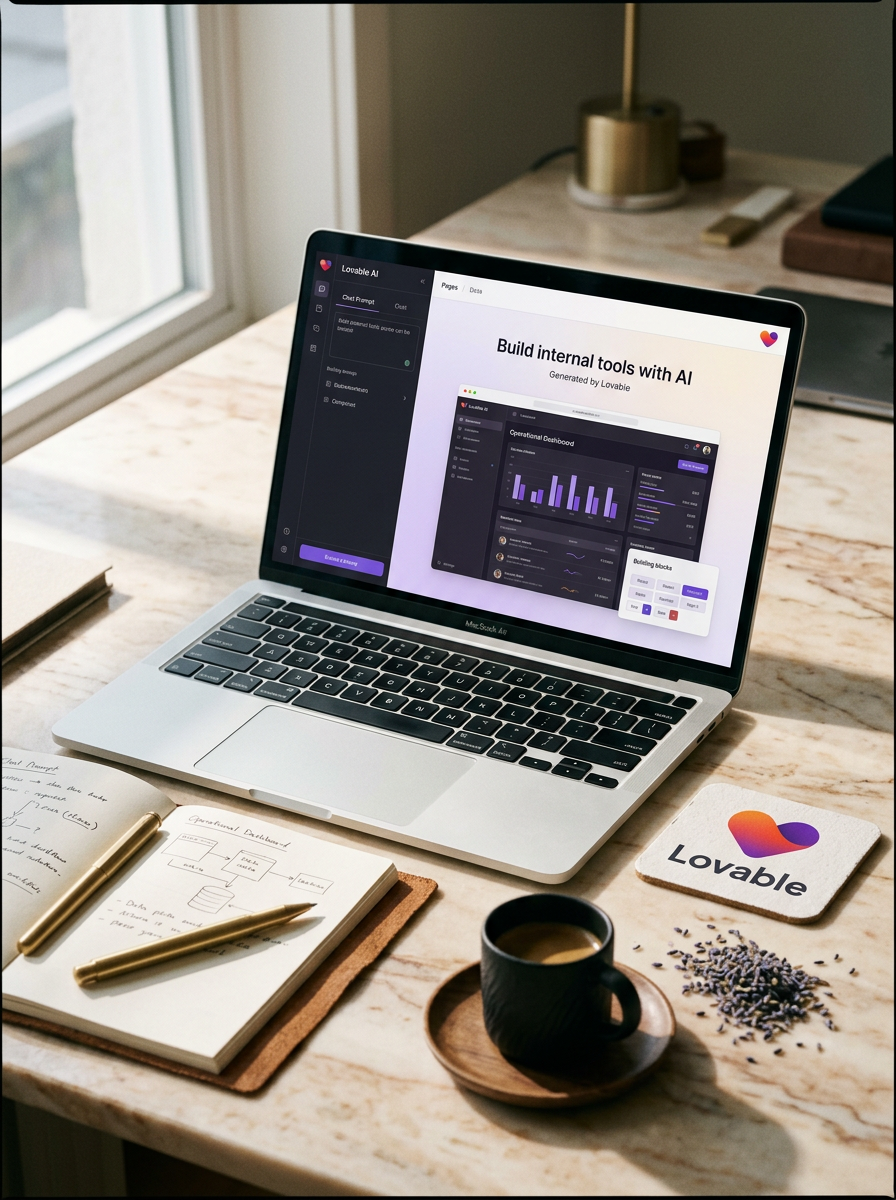
Lovable empowers you to build and ship custom internal tools remarkably fast, solving specific operational bottlenecks that generic SaaS can't. In a week, you can create high-impact apps like an AI-powered contract reviewer, a dynamic sales battlecard generator, or an automated user feedback triager.
The End of 'Good Enough' Software
Your company's software stack is a compromise. You pay for twenty SaaS products to solve twenty problems, but each solution only gets you 80% of the way there. That last 20% is where the real friction lives. It's the manual data entry, the awkward workarounds, the constant context switching between tabs. By 2026, the cost of this operational drag is no longer acceptable. The era of stitching together 'good enough' software is over. The future belongs to custom-fit operational tooling.
This isn't about hiring a team of engineers to spend six months building a perfect back-office system. This is about empowering operators-the product managers, marketing leads, and sales ops folks who feel the pain-to build their own solutions. Platforms like Lovable are making this possible. They combine a visual app builder with powerful backend logic, API integrations, and AI models. You get the speed of no-code with the power of real code.
Forget building another simple dashboard that just visualizes data. We're talking about building tools that do things. Tools that automate tedious workflows, generate mission-critical content, and provide intelligent assistance. Here are five such tools you or your team could realistically build and ship on Lovable within a week.
Tool 1: The AI Contract Review Copilot
This tool provides your sales team with an instant risk assessment on standard contracts, cutting legal review time from days to minutes. Imagine your Account Executive has a customer-edited MSA. Instead of creating a ticket for the legal team and waiting 48 hours, they upload it to an internal app. Sixty seconds later, they get a report: a risk score from 1-10, a list of non-standard clauses, and specific recommendations based on your company's playbook.
This isn't science fiction. The app's frontend is a simple file uploader built in Lovable. On the backend, Lovable's workflow engine sends the document's text to an LLM like Claude 3 or GPT-4. The trick is the prompt. You use Retrieval-Augmented Generation (RAG) by first feeding the model your own legal playbook from a vector database. The prompt essentially asks: 'Compare this uploaded contract against our standard terms. Highlight deviations, score the risk based on our predefined red flags, and explain why each deviation matters'.
This single tool can dramatically accelerate sales cycles by resolving a common bottleneck. Legal is freed up to focus on truly complex negotiations, and sales gets the velocity it needs to close deals. It's a perfect example of a high-leverage internal application.
Tool 2: The Dynamic Sales Battlecard Generator
This app generates up-to-the-minute competitive battlecards for your sales team on demand. Static battlecards stored in Confluence or Notion are dead on arrival. The market moves too fast. By the time you've written down a competitor's weaknesses, they've shipped a new feature or changed their pricing. Your reps need real-time intelligence, not a history lesson.
A dynamic battlecard generator solves this. A sales rep selects a competitor from a dropdown menu inside a simple Lovable app. The app's backend then springs into action. It pulls the latest mentions of that competitor from your team's Slack channels. It queries Gong or Chorus for recent call transcripts where the competitor was discussed. It pulls win-loss data from Salesforce. The app then feeds all this raw, timely data to an LLM with a prompt to summarize it into key sections: 'Recent Wins', 'Customer Objections', 'Effective Talking Points', 'Pricing Gaps', and 'Landmines to Watch For'.
The result is a battlecard that is never out of date. It reflects what your customers and your own team are saying right now. This moves your competitive strategy from reactive to proactive and gives your reps a tangible edge in live conversations.
Tool 3: The Automated User Feedback Router
This tool automates the triage of all incoming user feedback, saving your product team hours of manual work every single week. Your user feedback is a goldmine, but it's scattered everywhere: Intercom chats, App Store reviews, support tickets, tweets, subreddit posts. A product manager can spend their entire Monday just copying, pasting, and categorizing this firehose of information. It's a soul-crushing, low-leverage task.
An automated router built on Lovable can fix this. You use Lovable's API connectors (or a webhook aggregator like Zapier) to pipe all these sources into a single workflow. For each new piece of feedback, the workflow triggers an AI model. A cheaper, faster model like GPT-3.5-Turbo or Claude 3 Haiku is perfect for this. The model's job is twofold: classify the feedback (Bug, Feature Request, Usability Issue, Praise) and gauge the sentiment (Positive, Negative, Neutral).
Based on these tags, Lovable's logic engine routes the feedback. Bugs are automatically created as high-priority tickets in Linear or Jira, complete with the original user quote. Feature requests are added to a specific Slack channel or a Productboard collection. Praise is sent to a team-wide 'Wins' channel to boost morale. This system ensures every piece of feedback is seen, categorized, and sent to the right person without a human lifting a finger.
Tool 4: The Interactive Onboarding Buddy
This tool creates a personalized and interactive onboarding experience for new hires, answering their questions instantly and keeping them on track. Standard onboarding is a mix of boring checklists and awkward 'ask me anything' sessions. New hires often feel lost, and they ask the same 50 questions about benefits, IT setup, and company acronyms. This drains productivity from them and their managers.
Build an 'Onboarding Buddy' in Lovable. The app integrates with your HRIS (like Rippling or Workday) to pull the new hire's role, team, and start date. It then generates a personalized task list-not just 'Fill out HR forms', but 'Schedule a 1:1 with Jane, your tech lead' and 'Review the Q3 marketing strategy doc'.
The most powerful part is an integrated chatbot. You connect Lovable to a vector database containing all your internal documentation: your company wiki, HR policies, and team-specific guides. When a new hire asks, 'What's our policy on work-from-home?', the Lovable app uses RAG to find the relevant document and provides a direct, accurate answer from the source material. It's a personal guide for every new employee, available 24/7.
Tool 5: The Marketing Asset Localizer
This app helps your marketing team generate culturally relevant copy and imagery for global campaigns in a fraction of the time. Sending a US-centric ad campaign to audiences in Japan or Brazil is a recipe for failure. But managing localization across dozens of markets is a massive operational headache. It involves spreadsheets, language service providers, and endless back-and-forth.
A Lovable-built localizer streamlines this. A marketer inputs the core campaign asset: the headline, body copy, and call to action. They select the target locales, say 'Germany', 'Mexico', and 'South Korea'. The app then calls an LLM API, but with a series of chained, context-rich prompts. For Germany, the prompt might be: 'Translate this ad copy to German. Adopt a formal, direct tone (Sie). Ensure the call to action is clear and unambiguous. Avoid American-style hype and idioms.' For Mexico, it might be: 'Translate this to informal Latin American Spanish. Infuse it with a warmer, more community-oriented tone. Suggest a local cultural reference that aligns with the product's value.'
This goes beyond simple translation. It's about transcreation. The tool can even be extended to integrate with an image API like Unsplash to suggest alternative photos that are more culturally resonant for each region. The marketing team gets a dashboard with all the localized variants, ready for review and deployment. It turns a week-long process into an afternoon's work.
Quick Comparison
| Tool Name | Primary Impact | Build Time (Est.) | Key Integrations | | :--- | :--- | :--- | :--- | | AI Contract Copilot | Sales Velocity | 3-5 Days | LLM API, Vector DB, File Storage | | Sales Battlecard Gen | Competitive Edge | 4-6 Days | Slack, Gong/Chorus, Salesforce | | Feedback Router | PM Productivity | 2-4 Days | Intercom, Zapier, Linear/Jira | | Onboarding Buddy | Employee Ramp Time | 5-7 Days | HRIS (Rippling), Vector DB, Slack | | Asset Localizer | Marketing Scalability | 3-5 Days | LLM API, Unsplash/Pexels API |
Why should we build instead of buy?
You should build when the problem is unique to your company's process and a generic SaaS tool creates more friction than it removes. Off-the-shelf software is designed for the median company. It imposes its own workflow on you. If your competitive advantage comes from a unique sales motion, a proprietary data analysis method, or a specific customer service flow, forcing it into a generic tool's box will actively harm your business. Building with Lovable isn't about reinventing the wheel. It's about building the specific connecting rods your unique engine requires.
What skills do I need to build these?
You need to be what we call 'systems-literate', but you don't need to be a professional software engineer. If you understand how APIs work in principle (i.e., you know what a GET and POST request are), have a logical mind for mapping out workflows (if this, then that), and are comfortable with a visual UI builder, you have the foundation. The most important skill is a deep understanding of the business problem you're trying to solve. For these specific AI-powered examples, you'll need to learn the basics of prompt engineering, but honestly, that's a skill everyone in operations should be developing anyway.
How do we handle security with custom apps?
You handle it by leveraging the enterprise-grade security of the underlying platform and services. Lovable, as a modern development platform, is built with security at its core. It manages user authentication, permissions, and audit logs. When you connect to other services like Salesforce or an LLM API, you use secure API keys and tokens managed within Lovable's environment. The data from your internal systems flows through secure, encrypted channels. This is often more secure than having employees download data into spreadsheets or paste sensitive information into a public-facing tool. The key is to enforce role-based access within your Lovable app from day one, ensuring users can only see and do what they absolutely need to.
The Briefing
The best of Lovable, once a week.
Deep reviews, founder case studies, and growth tactics. No filler.
No spam. One-click unsubscribe.
Build something with us
Start Building with Lovable
Open Lovable, write your first prompt, and ship the thing you have been thinking about for too long.
Start Building with Lovable